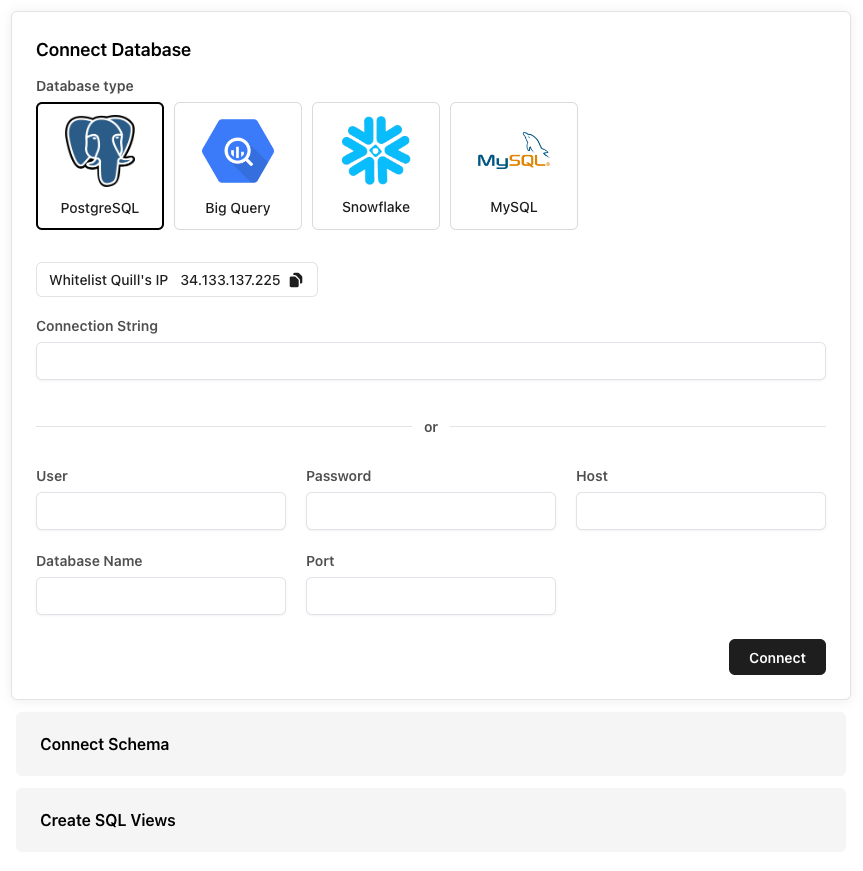
To create a read-only user in PostgreSQL, do the following:
1
Create a new user
PostgreSQL
-- Replace 'password' with a strong password.CREATE USER quill_read_only WITH PASSWORD 'password';
2
Grant CONNECT privileges
PostgreSQL
-- Allows the user to connect to the database.GRANT CONNECT ON DATABASE your_database TO quill_read_only;
3
Grant USAGE on the schema
PostgreSQL
-- Allows the user to access the objects within the schema.GRANT USAGE ON SCHEMA your_schema TO quill_read_only;
4
Grant SELECT privileges on the schema
PostgreSQL
-- Allows the user to read data from the tables.GRANT SELECT ON ALL TABLES IN SCHEMA your_schema TO quill_read_only;
The connection string for the read-only user we just created will be something like: postgresql://quill_read_only:password@db.example.com:5432/your_database.
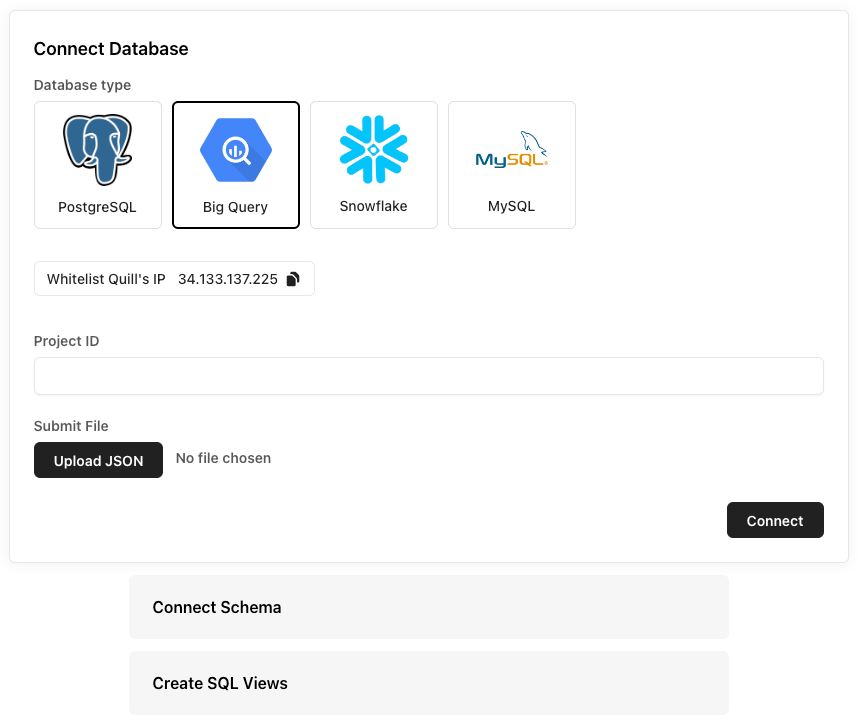
To create a read-only user in Big Query, do the following:
1
Create a service account for Quill
In the Google Cloud Console, navigate to the IAM & Admin > Service Accounts page. Click Create Service Account and follow the prompts to create a new service account.
2
Grant permissions to the service account
Grant the bigquery.dataViewer role to the service account for a dataset. You can do this by navigating to the dataset’s Permissions page and adding the service account with the bigquery.dataViewer role.
3
Create the access token
Create a new JSON key for the service account by clicking the Actions dropdown next to the service account on the IAM & Admin > Service Accounts page, and then selecting Create Key. Select JSON as the key type and click Create. This will prompt you to save it one your local machine.In the next step you’ll upload this JSON file into the Quill BI Platform.
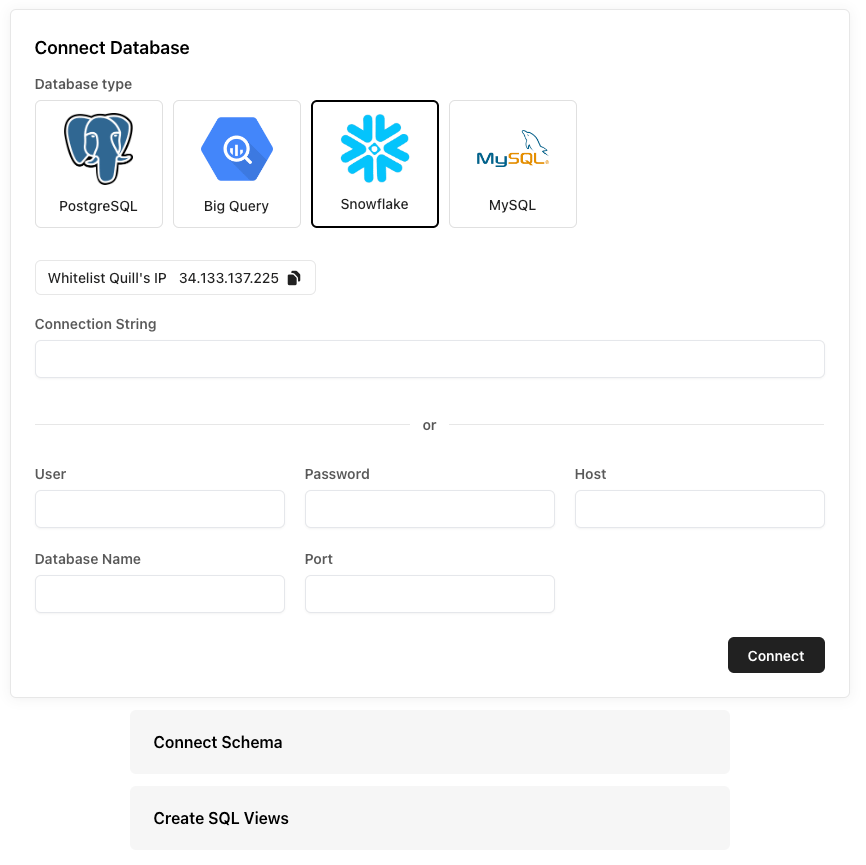
To create a read-only user in Snowflake, do the following:
1
Create a new user
Snowflake SQL
-- Replace 'password' with a strong password.CREATE USER quill_read_only PASSWORD 'password';
2
Create a new read-only role
Snowflake SQL
-- Creates a role specifically for read-only access.CREATE ROLE quill_read_only_role;
3
Grant SELECT privileges to the role
Snowflake SQL
-- Allows the role to read data from the tables.GRANT SELECT ON ALL TABLES IN SCHEMA my_schema TO quill_read_only_role;
4
Assign the user to the role
Snowflake SQL
-- Gives user the permissions of the roleGRANT quill_read_only_role TO quill_read_only;
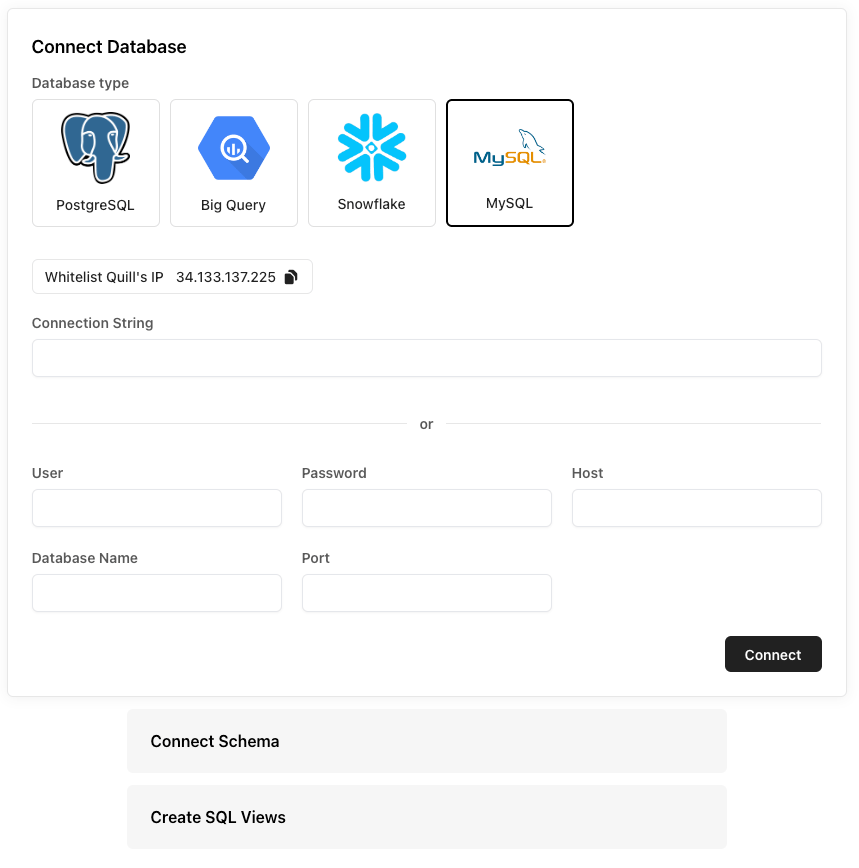
To create a read-only user in MySQL, do the following:
1
Create a new user
MySQL
-- Replace 'password' with a strong password.CREATE USER 'quill_read_only'@'%' IDENTIFIED BY 'password';
2
Grant USAGE on the schema
MySQL
-- Allows the user to read data from the tables.GRANT SELECT ON your_database.* TO 'quill_read_only'@'%';
The connection string for the read-only user we just created will be something like: mysql://quill_read_only:password@db.example.com:3306/your_database.
Go to https://app.quill.co/onboard and enter the read-only database connection string that we created in the last step.
If you’re using our fully-managed Quill instance, make sure to add the Quill
server to your database IP whitelist, if you have one. Requests from Quill
will always come from 34.133.137.225, 209.71.81.30/32, or 209.71.101.146
For more information about data and access control, you can read our
self-hosting guide here.
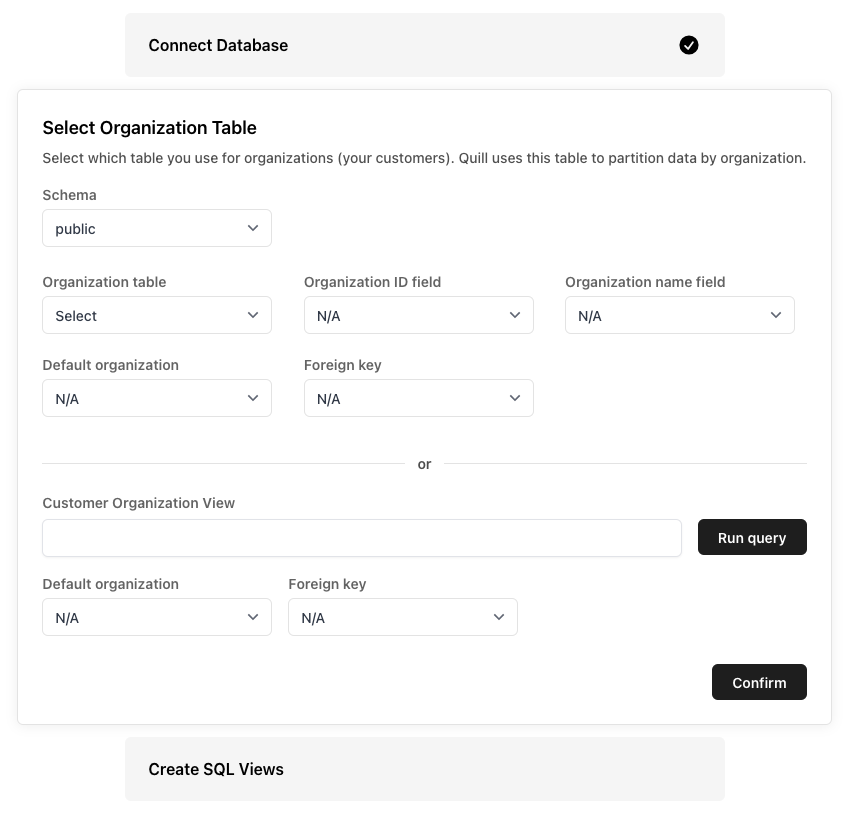
The Quill platform provides powerful filtering and reporting tools to help you get the insights you want, faster. Since Quill provides organization-based filtering out-of-the-box, simply let us know which table to use and Quill will automatically partition your data by organization.
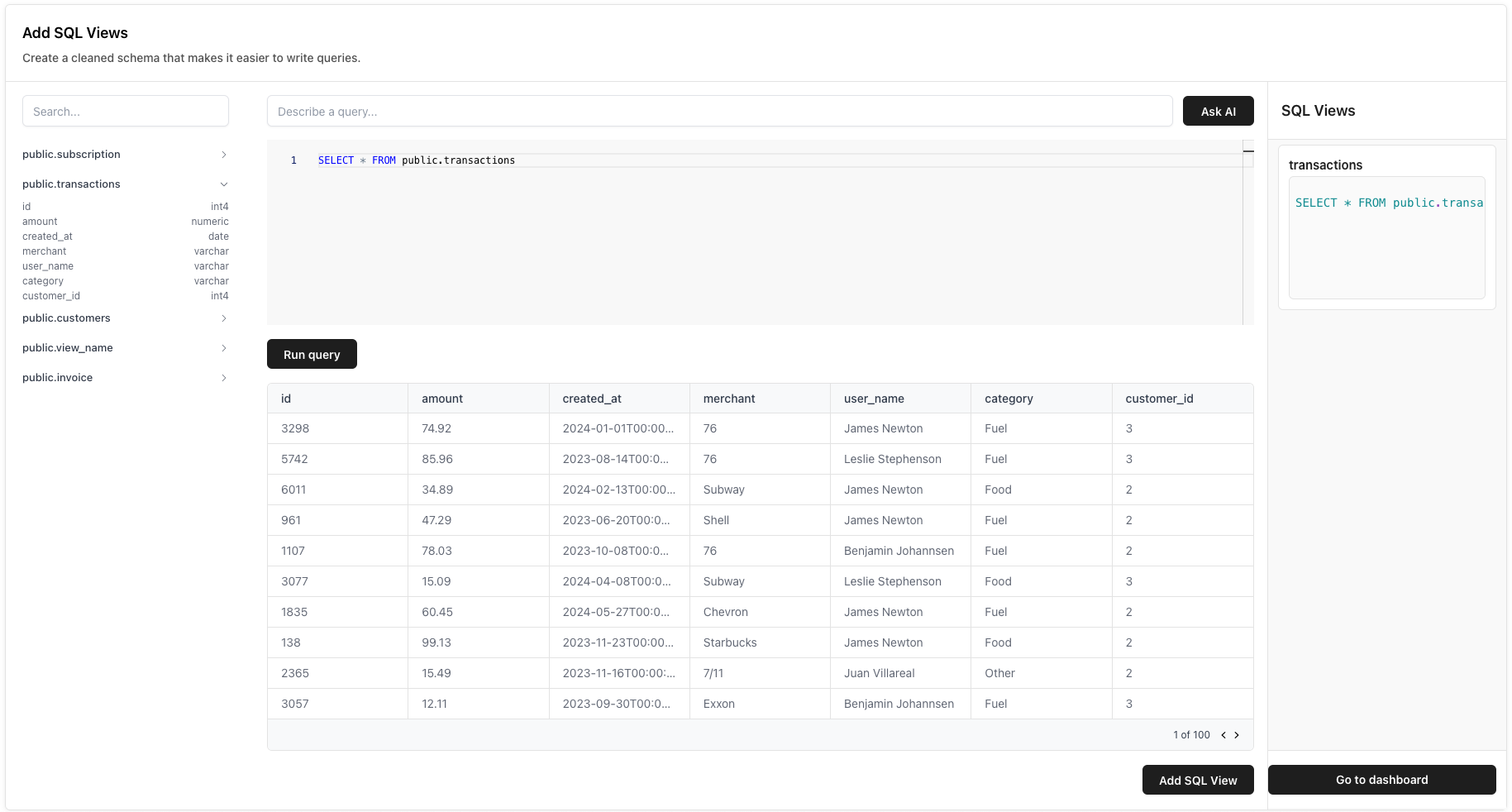
Create a cleaned schema that makes it easier to write queries and reports. The views you create here will be used to create charts and tables later on. Don’t worry, you can always create and edit these views later.